0 views today · 159 views all time
Turbo Dump Valve
The Lotus Esprit does not come fitted with a Dump Valve for the turbo. This is unusual because, especially in high boost applications, the back pressure caused by lifting off the throttle can cause the compressor of the turbo to stall. In extreme cases, the compressor can actually shatter.
After a dump valve is fitted, you will notice an immediate change in feel to the car, especially after changing gear. This is because the turbo is kept spinning during closed-throttle conditions and is therefore able to provide full-boost quicker.
What's Needed
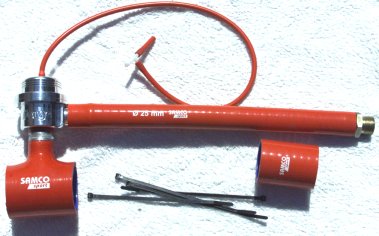
Here is what's needed to install a dump valve onto a Lotus. This kit will be available for purchase soon.
Installation
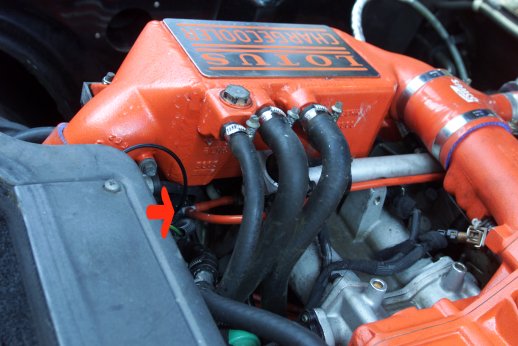
The dump-valve needs to connect to the manifold behind the throttle butterflies. This is can done where the MAP sensor connects; however, there is another connection at the back of the fuel rail.
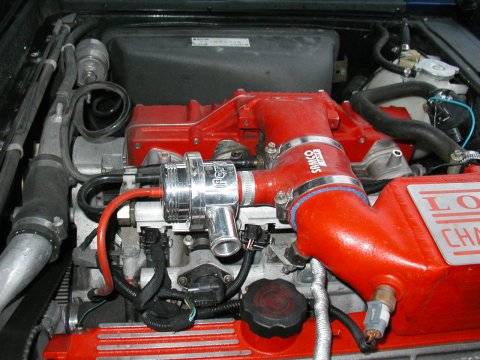
This picture shows the connection by the MAP sensor. The picture under "Finished Job" shows it connected at the rear.
Selecting the correct opening pressure for the valve is initially difficult. As previously stated, the valve works by the differential pressure that's present across it. Also, to provide better throttle response, the Esprit's ECU operates the turbo in open-loop mode during part throttle openings.
What this means is that a dump valve with an opening pressure of 1.0 bar (gauge) could be used. At full throttle openings this would work fine. However, at certain rev ranges, the manifold pressure will be at a low depression at the same time the turbo is spinning up, pressurising the induction system in front of the throttle butterfly valves. In this situation, the dump valve will see a higher pressure differential causing it to open and vent the induction system to atmosphere.
What this means is that you need to choose a dump valve that opens at a much higher pressure that originally thought.
Choosing A Dump-Valve
The Esprit uses a speed-density fuel system arrangement. Cars that use this arrangement can (usually) be identified by the lack of any Mass-Air measuring device.
The ECU works out the volume of air entering the engine (Mass-Air Flow) by measuring the Mass-Air Temperature (MAT) and the Coolant Temperature at the inlet manifold (CTS). It uses these temperatures combined with Volumetric Efficiency look-up tables to approximate the air-flow at a given manifold pressure (MAP).
What all this means is that you don't have to use a re-circulating valve; a vent-to-atmosphere type is all that's necessary. The disadvantage in using this type is the noise it produces during gear-changes; it sounds like the air-brakes of a large lorry braking behind your head!
I'm using a re-circulating type with the hose fed to the wheel-arch.
Finished Job
Want More Information?
The guy that did the initial research is Justin McAulay from Somerset in the UK, until recently a Lotus Esprit S4 owner. Please contact him directly if you have any questions referring to the installation and/or sources for the various components used during the install.
Justin can be contacted via Email at:
After recent experience with his Escort RS Turbo, Justin concluded that a piston-type dump valve was the only type of valve worth fitting to an Esprit. All hoses should be silicone and of the highest quality.
Times page accessed since August 2001:
Page created by: mail@andywhittaker.com
Changes last made on: 18 May 2002 16:20 -0400